
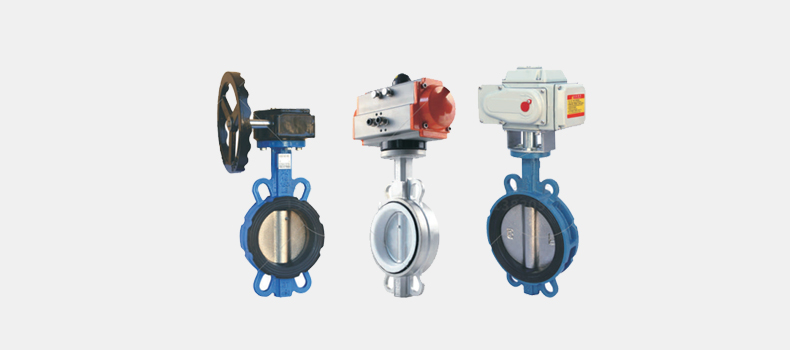
Detailed Analysis of Butterfly Valve Knowledge: Structure, Principle, Advantages and Disadvantages, and Installation Methods
The butterfly valve, also known as the flap valve, is a simple type of regulating valve. Its closing element (valve disc or butterfly plate) is in the form of a circular disc and is opened and closed by rotating around the valve axis. This type of valve is suitable for controlling various fluids, including air, water, steam, as well as various corrosive media, slurries, oils, liquid metals, and radioactive media, etc. In pipeline systems, the butterfly valve mainly plays the important roles of cutting off and throttling. The closing element - the butterfly plate - rotates within the valve body along its own axis, thereby achieving effective control of the fluid flow.
The working principle of a butterfly valve is that its disc-shaped opening and closing element rotates approximately 90° within the valve body, thereby enabling the opening, closing or flow regulation of the medium. This type of valve has a simple structure, small floor space, light weight, low material consumption, compact installation dimensions, and small driving torque, making the operation simple and rapid. At the same time, the butterfly valve also has excellent flow regulation function and outstanding closing sealing characteristics, so it has developed rapidly in the past decade and has become a highly favored type of valve.
The construction of the butterfly valve
The core structure of the butterfly valve consists of the valve body, valve stem, butterfly plate and sealing ring. The valve body is designed as a cylindrical shape, with a relatively short axial dimension, and a butterfly plate is built in. This design enables the butterfly valve to rotate flexibly during operation, thereby achieving the control of fluid media through on-off operation.
The structural diagram of the butterfly valve is as follows:
Through the structural diagram, we can more clearly see the various components of the butterfly valve, including the valve body, valve stem, butterfly plate, and sealing ring, and other key parts. Such a design enables the butterfly valve to have excellent flexibility and durability in the field of fluid control.
Summary of Advantages
The butterfly valve, as a type of fluid control equipment, demonstrates numerous advantages due to its unique structure and design. The main advantages include:
High flexibility: The design of the valve plate in the butterfly valve enables more flexible fluid control, allowing for quick response and precise flow regulation.
High durability: The butterfly valve, made of high-quality materials and precisely processed, ensures excellent durability and is suitable for various harsh working environments.
Maintenance is simple: Its compact structure and easy disassembly make daily maintenance and upkeep straightforward and cost-effective.
Energy conservation and environmental protection: The butterfly valve can achieve efficient energy utilization during the fluid control process, reducing energy waste and meeting the requirements of energy conservation and environmental protection.
In conclusion, due to its outstanding flexibility and durability, the butterfly valve is playing an increasingly important role in the field of fluid control. Outstanding fluid control performance: When the butterfly valve is fully open, the thickness of the butterfly plate is only a minor resistance for the fluid to pass through the valve body, thus keeping the pressure drop through the valve at the lowest level. Moreover, due to the compact structure of the butterfly valve, its length and overall height are both small, enabling rapid opening and closing actions, and thus demonstrating excellent flow control characteristics.
The ideal choice in the field of large-diameter regulation: Within the range of approximately 15° to 70° for the opening angle of the butterfly valve, its flow control function performs particularly sensitively. Therefore, the application of the butterfly valve in the field of large-diameter regulation has become quite widespread.
Compact structure, obvious cost advantage: The butterfly valve, with its lightweight structure and compact main body design, has found its place in the pipeline system. Its flow control mechanism uses a thin metal disc, although it is small in size, it has excellent strength and can effectively regulate the flow of fluid. Moreover, the manufacturing materials of the butterfly valve use less, compared to other valves of the same size, such as ball valves, etc., its price is more affordable, providing an economical and practical solution for narrow-position pipeline systems.
Fast and efficient sealing: The unique design of the butterfly valve enables it to achieve sealing quickly upon startup. This feature makes it an ideal choice for high-precision flow control applications.
Low pressure drop and high pressure recovery: Although the valve disc is always submerged in the fluid, the design of the butterfly valve enables it to maintain a low pressure drop. This low pressure drop characteristic is crucial for optimizing the pumping efficiency of the management system and reducing energy consumption. Moreover, its unique design ensures that the fluid can quickly return to a high-pressure state after passing through the valve.
Simple maintenance requirements: The internal structure of the butterfly valve is simple. Compared to other valves, it does not have "trap" areas for capturing fluids or impurities. Therefore, the maintenance requirements are relatively low, reducing the need for frequent maintenance and intervention. Additionally, the installation process of the butterfly valve is quite simple. It only requires clamping between adjacent pipe flanges, without the need for complex welding steps.
Simple operation: The structure of the butterfly valve is designed to be very compact, and it is lightweight. Therefore, only a relatively low torque is required to operate it easily. The thin metal butterfly plate can easily overcome the frictional resistance of the fluid, and only a small amount of force is needed to achieve smooth opening and closing. Automation is easily achievable: Since the small actuators can provide sufficient torque for the butterfly valve, it makes the operation more convenient and thereby reduces operating costs. This is mainly because the small actuators consume less power and have little impact on the overall cost increase of the valve. Limitations and Challenges
Although small actuators have significant advantages in providing convenient operation for butterfly valves, they also have some drawbacks. One of these is that they may not be able to cope with extreme environmental conditions, such as high or low temperatures or corrosive environments, which could limit their application scope. Additionally, although small actuators have advantages in terms of power consumption and cost, their performance may not meet specific application requirements in certain situations. Therefore, when choosing an actuator, it is necessary to consider the specific application scenarios and requirements comprehensively.
Application limitations of butterfly valves
The butterfly valve has certain limitations in terms of throttling. It is mainly suitable for throttling operations in low-pressure environments, and its opening range is typically limited to between 30 degrees and 80 degrees. Applications beyond this range may result in the butterfly valve being unable to effectively perform the throttling task.
2. Butterfly valves are prone to problems such as cavitation and flow blockage.
When the butterfly valve is in the open position, it does not provide a completely sealed port. At this time, the presence of the valve disc in the fluid flow path often leads to an increase in the accumulation of impurities around the valve, thereby raising the probability of cavitation occurrence.
3. Relatively poor corrosion resistance
Compared with gate valves and ball valves, the corrosion resistance of butterfly valves is relatively weak. During the flow of fluid through a butterfly valve, due to the erosion effect of the fluid, the material of the disc may gradually deteriorate, thereby affecting its sealing performance. Especially when dealing with viscous fluids, the corrosion rate of the butterfly valve may further accelerate.
4. Difficulty in pigging operations
When the valve disc of the butterfly valve is fully open, it may hinder the cleaning process of the entire system, resulting in the inability of the pipeline containing the butterfly valve to carry out effective pigging operations.
Installation and Maintenance of Butterfly Valves
The installation of the butterfly valve is crucial for its normal operation. During the installation process, it is necessary to ensure that the correct steps and specifications are followed to ensure that the butterfly valve can function smoothly. At the same time, regular maintenance is also indispensable, as it can promptly detect and address any issues. Resolve potential problems in order to extend the service life of the butterfly valve.
When installing the butterfly valve, it is necessary to ensure that the valve disc is in a closed position.
2. The opening position of the butterfly valve should be precisely determined based on the rotation angle of the butterfly plate.
3. If the butterfly valve is equipped with a bypass valve, before opening the main valve, the bypass valve should be opened first for pre-treatment.
4. During the installation process, it is essential to strictly follow the installation manual provided by the manufacturer. Especially for the heavy butterfly valves, ensure that a stable foundation is set up.
Detailed Explanation of Construction and Installation Key Points
When installing a butterfly valve, several key points need to be noted to ensure smooth construction and long-term use. First, the valve disc must be in a closed position at the beginning of installation, which is the foundation for the normal operation of the butterfly valve. Secondly, the opening position must be precisely controlled according to the rotation angle of the butterfly plate to achieve precise adjustment. Additionally, if the butterfly valve is equipped with a bypass valve, it should be opened first before starting the system to reduce the system pressure and ensure smooth startup. Finally, during the installation process, it is necessary to strictly follow the detailed installation instructions provided by the manufacturer, and for butterfly valves with heavy weights, the foundation should be particularly solidified to ensure stable installation. By following these points, you will be able to successfully complete the installation of the butterfly valve.
The installation position, height and inlet/outlet direction of the butterfly valve must strictly follow the design requirements. At the same time, it is necessary to ensure that the connection is firm and tight, with no leakage.
2. For the manual valves installed on the insulated pipes, the handles must face upwards and must not face downwards.
3. Before installing the valve, a comprehensive visual inspection must be conducted. The nameplate of the valve should comply with the national standard "General Valve Marking" GB 12220. Especially for valves with a working pressure exceeding 1.0 MPa or those serving as cut-off devices on the main pipeline, strength and tightness tests must be carried out before installation. During the strength test, the test pressure is 1.5 times the nominal pressure, and it should be maintained for at least 5 minutes. The valve body and packing areas should show no leakage for the test to be considered successful. In the tightness test, the test pressure is 1.1 times the nominal pressure, and the duration should comply with the GB 50243 standard. The same criterion of no leakage at the valve disc sealing surface is used as the passing standard.